
Three Symbolic Tattoos With Powerful Stories: Mímir, Ouroboros, and Icarus
Some tattoos hold entire mythologies inside them.
Not because they’re large, and not because they’re overly complex — but because the stories behind them carry weight. When myth meets realism, even a single composition on the arm, back, or leg becomes a narrative that feels timeless.
These three tattoos — Mímir, the Ouroboros with the Tree of Life, and Icarus — are powerful examples of how mythology can shape a design, guide the composition, and give a tattoo meaning far beyond the image itself.
1. Mímir — The Guardian of Wisdom (Forearm)
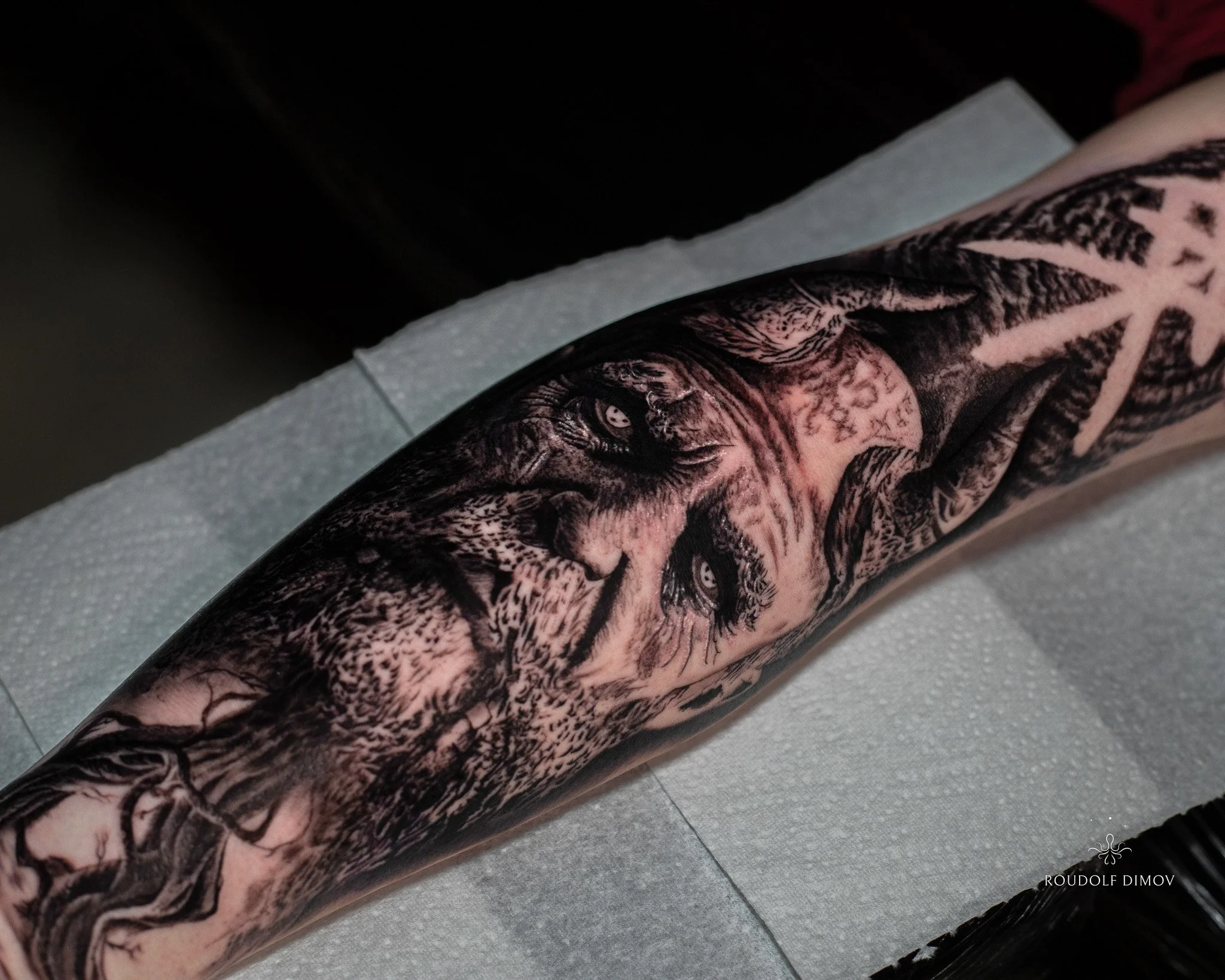
Mímir is one of the most enigmatic figures in Norse mythology. His name comes from the Old Norse word mímr, meaning “the one who remembers” or “the wise one.” He was the keeper of the Well of Wisdom, a sacred source of knowledge buried beneath the roots of Yggdrasil. Gods came to him for insight, and even Odin — the Allfather himself — sacrificed one of his eyes into the well in exchange for a drink of Mímir’s wisdom.
Later in the mythology, Mímir is beheaded during the war between the Aesir and the Vanir. Instead of allowing him to fade into legend, Odin preserved his head with spells so he could continue seeking counsel from it. The message is clear: wisdom is worth sacrifice, and guidance is worth protecting even beyond death.
How the Tattoo Was Built
This tattoo brings Mímir’s myth into one cohesive composition. The portrait shows him as he is often imagined — reserved, weathered, and carrying the kind of silence that feels heavy with knowledge. Above him sits his rune, drawn with subtle negative space and treated almost like a supernatural marker. Beneath him, a stylised tree flows downward, referencing both the well he guarded and the world tree that holds the Norse cosmos together.
Why Mímir is meaningful as a tattoo
Mímir represents:
clarity
guidance
deep thinking
memory
truth
the wisdom you don’t get for free
For many people, choosing Mímir is choosing a reminder to think deeper, to seek understanding before action, and to stay grounded even when life becomes chaotic.
2. Ouroboros & The Tree of Life — Cycles and Renewal (Back)
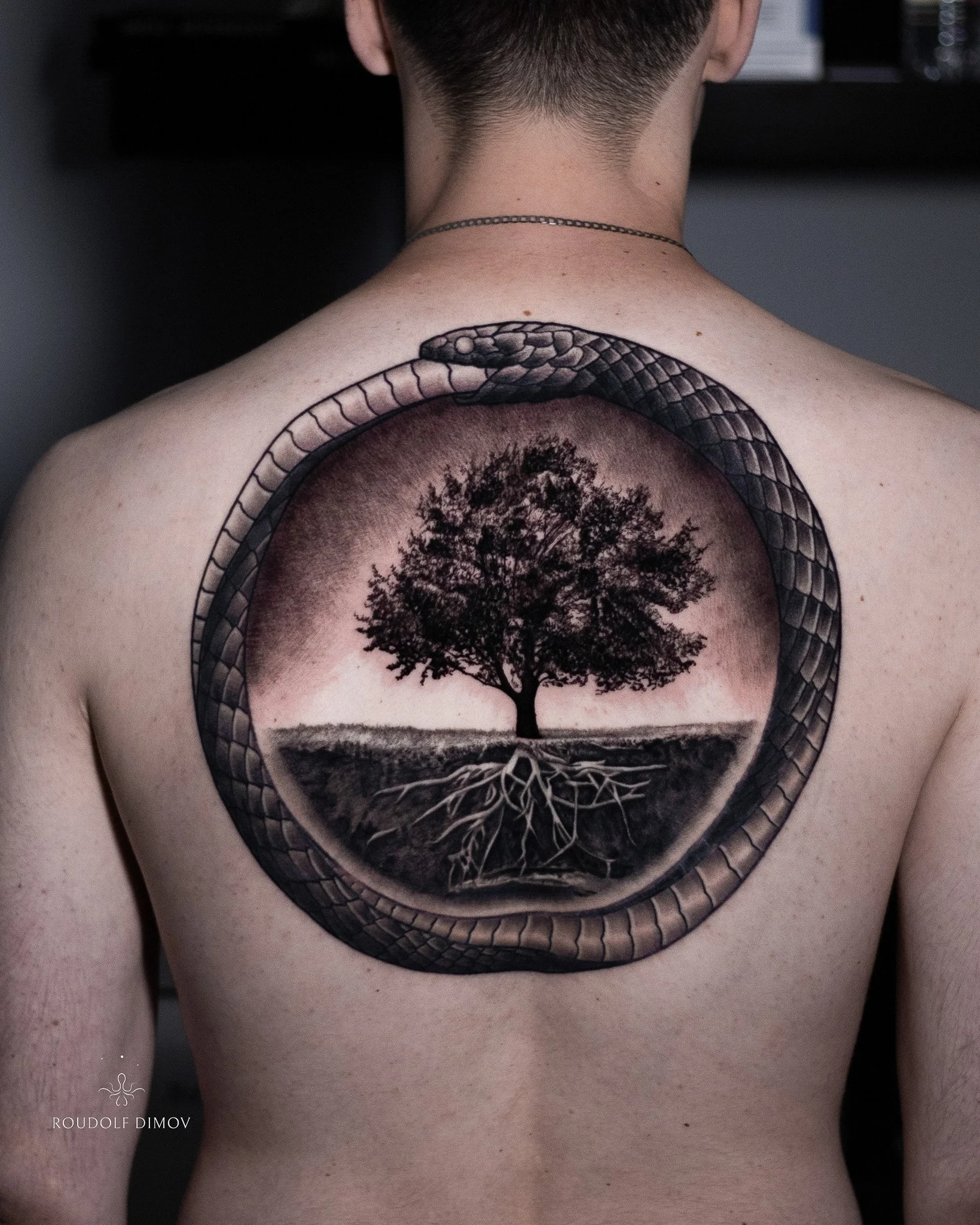
The Ouroboros is one of the oldest symbols in human history. It appears in Egyptian funerary texts, Greek philosophy, Norse manuscripts, early Buddhist imagery, and even in alchemical diagrams. The serpent consuming its own tail represents the cycle that never ends: beginnings that rise from endings, destruction that creates renewal, and the truth that life constantly folds in on itself in order to start again.
Within this circle, we placed the Tree of Life, another symbol found across cultures. In Norse mythology it is Yggdrasil, the axis of the universe. In Celtic lore it connects the heavenly, earthly, and underworld realms. In Middle Eastern traditions it becomes the origin of life, and in mysticism it represents the structure of existence itself.
Where the Ouroboros speaks of eternal cycles, the Tree of Life speaks of growth, grounding, and balance. Together, they form a complete philosophy.
What the Tattoo Represents
Renewal and rebirth
Balance between endings and beginnings
Personal evolution
Roots, ancestry, and growth
The connection between all phases of life
Why This Composition Works
The Ouroboros forms a perfect frame for the tree, creating a cohesive design that feels ancient yet minimal. The contrast between the bold circle and the delicate branches makes the tattoo feel balanced, intentional, and deeply symbolic without needing extra elements.
3. Icarus — Ambition, Light, and Human Desire (Calf)
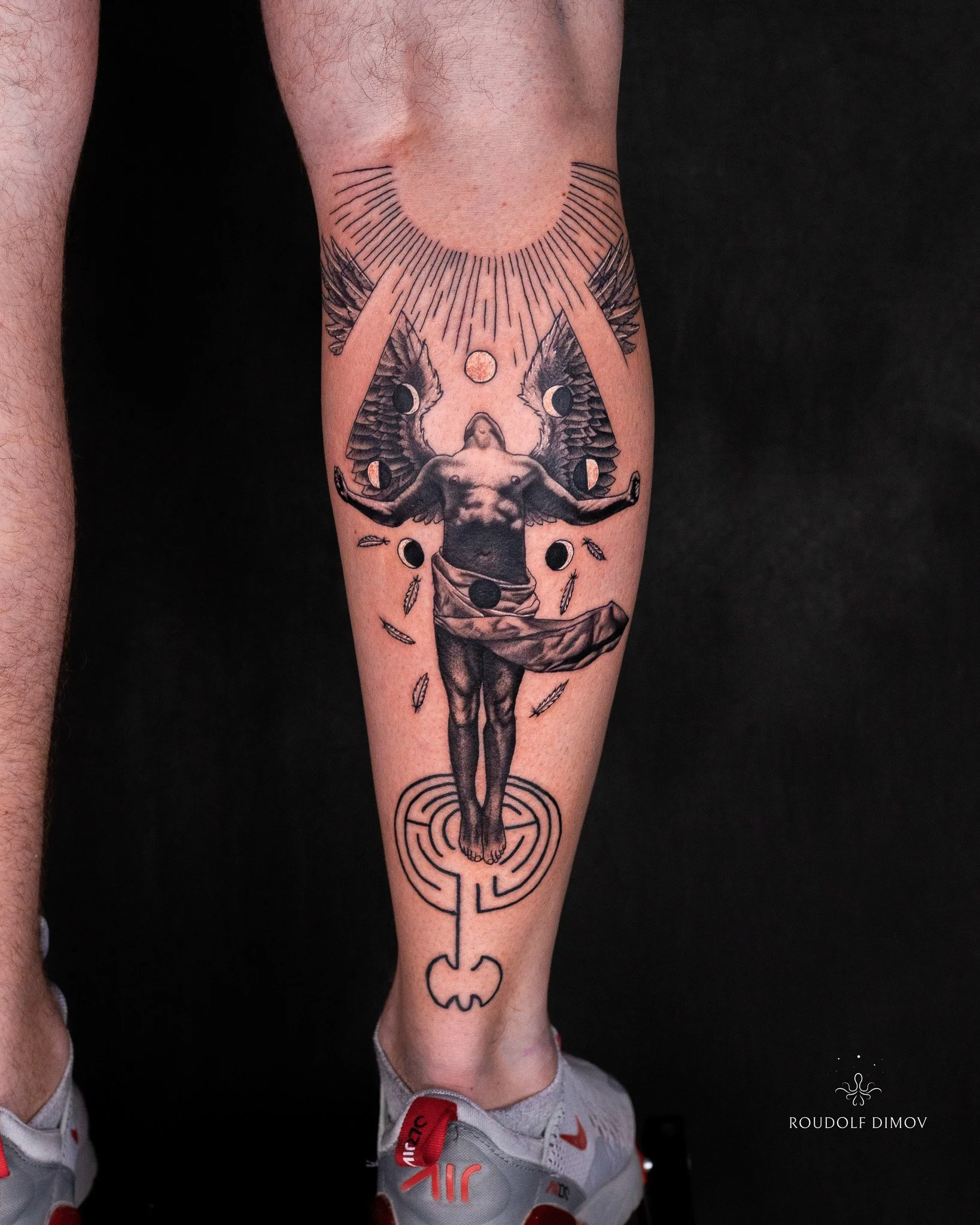
The myth of Icarus is often reduced to a warning about pride — “don’t fly too high.”
But that’s only the surface of the story.
In Ovid’s Metamorphoses, Icarus is the son of Daedalus, the brilliant inventor trapped in Crete under King Minos. Daedalus creates wings made of feathers and wax so he and his son can escape the island. Before they take flight, he warns Icarus not to fly too close to the sun or too close to the sea. He teaches him balance, discipline, and caution.
But when Icarus rises into the sky and feels the freedom of flight, he reaches upward — not out of arrogance, but out of the human desire to experience something extraordinary. His myth is less about failure and more about the beauty and danger of ambition, the longing for something more, and the instinct to chase meaning even when the outcome is uncertain.
Symbolism Built Into the Tattoo
The sun above him represents enlightenment, desire, and the extreme pull of human curiosity.
His upward movement captures ambition in its purest form — the moment of ascent.
The wings behind him are stylised, keeping the design rooted in realism but still symbolic.
The maze below references Daedalus and the idea that every escape, every rise, begins with a winding path of choices.
Why This Tattoo Matters
Instead of focusing on the fall, this design celebrates the rise — the moment before consequence, when ambition feels alive and limitless.
Why Mythology Tattoos Resonate
People choose mythology tattoos because these stories mirror real life.
They speak to universal experiences: wanting wisdom, longing for growth, searching for meaning, taking risks, rising again after difficulty, understanding cycles, and connecting to something older than ourselves.
Mythology gives clients a language for emotions that are hard to express.
It transforms personal philosophy into visual storytelling.
And it gives tattoos a depth that grows over time, just like the stories themselves.
FAQs
Do mythology tattoos need multiple symbols?
Not necessarily. A single symbol can be powerful, but combining elements often deepens the meaning and helps tell the story visually.
Can these tattoos grow into bigger projects later?
Yes. Each design can expand into a sleeve, backpiece, or a larger mythological theme.
Is realism a good style for mythological imagery?
Absolutely. Realism brings ancient stories to life with emotion, depth, and dramatic lighting.
Do I need to know the full myth before getting one?
No. Many clients only know the basics. I help guide the symbolism so it fits your interpretation.
Can I mix myths from different cultures?
You can — as long as the meanings connect. Composition and narrative flow matter more than matching mythological origins.
🔎 Explore More FAQs:
https://www.roudolfdimovart.com/faq
Start Your Tattoo Journey
Whether you have a full idea or just a theme, we can shape it together.
👉 Large Projects:
www.roudolfdimovart.com/large-projects
Bring your story. I’ll shape it into art.
👉 Book a Consultation:
https://www.roudolfdimovart.com/booking
📍 London
✉️ info@roudolfdimovart.com