
From Idea to Full Chest & Upper Arm Tattoo: A Behind-the-Scenes Story of Designing a Three-Part Body Project
Some tattoos begin with a finished vision.
Others start with only a direction — a feeling — and find their shape over time.
This project belonged to the second category.
And that’s exactly why it became one of the most rewarding collaborations I’ve had.
My client came in wanting a tattoo that covered his chest and both upper arms. It was his first tattoo ever, which is rare for a piece this size. First-timers usually start small, test the waters, and build from there. But he had a bigger goal in mind: a meaningful project that represented his personality, his travels, his heritage, and most importantly, something dedicated to his daughter.
He brought ideas, references, and inspiration — but not a clear composition.
And that’s where the journey began.
Starting With a Conversation
Before any pencil touches paper, the most important part of a large-scale tattoo is the conversation. I wanted to understand:
What he wanted each section to represent
What the tattoo should feel like when seen as a whole
What style he naturally leaned toward
How much detail he felt comfortable with
How open he was to artistic direction
Clients often think they need to know everything before the consultation. They don’t. Sometimes all you need is a theme and trust in the process. He had both — and that made everything smoother.
Very early, I suggested one crucial change to his initial idea:
Instead of designing the chest and both upper arms all at once, we would approach the project part by part.
When a client doesn’t fully know what they want, sketching an entire three-area layout can create confusion, overwhelm, and forced decisions. Working in sections gives the design room to evolve naturally and keeps the client focused on one story at a time.
He agreed right away.
Part I — The Chest: Two Cultures, One Story
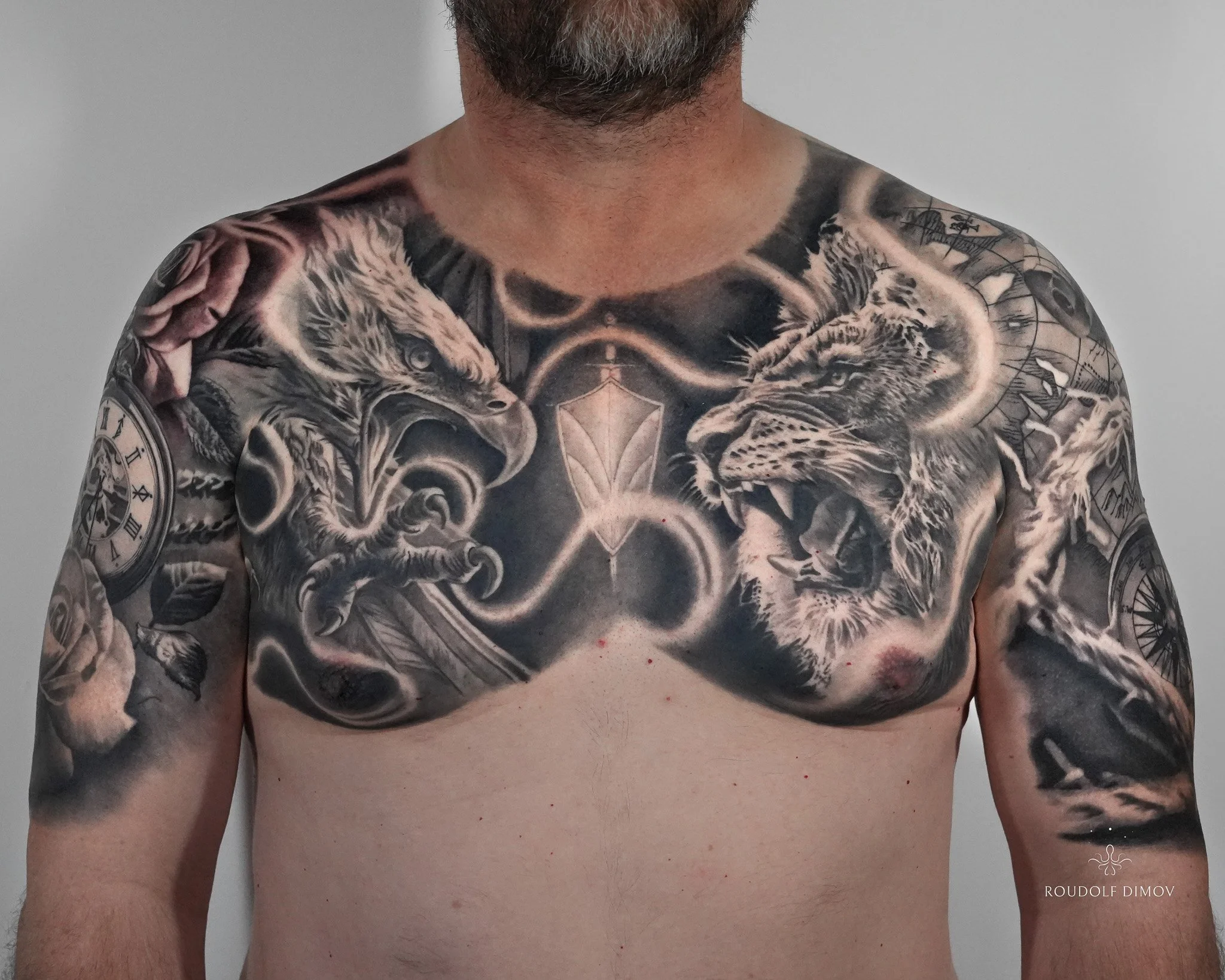
The chest became the foundation of the whole project. It often is — it’s central, it’s symmetrical, and it sets the visual rhythm for everything around it.
His Request
He wanted:
An eagle to represent his English side
A lion to represent his German side
A shield and sword in the centre
Strong symbols. But symbols alone don’t make a great tattoo — the composition does.
Finding the Structure
During the early sketches, the chest was the most challenging part. Not because of the subjects, but because of the layout. When you place a lion, an eagle, and a shield next to one another, the risk is always the same:
It can look like three separate pictures instead of one unified piece.
To solve this, I experimented with ways to link everything together without forcing the imagery. Eventually, I introduced negative-space flow lines — controlled empty areas that move between the elements and give the eye a path to follow.
This did three things at once:
Connected the animals and shield into a single composition
Added motion, preventing the design from feeling stiff
Created visual continuity that would later extend into both arms
Once we finalised the sketch, everything clicked. The eagle and lion balanced each other. The shield anchored the centre. The flow tied it all together.
When the chest was close to being finished, we moved to the next chapter.
Part II — The Travel Arm: A Compass, A Map, and A Story of Movement
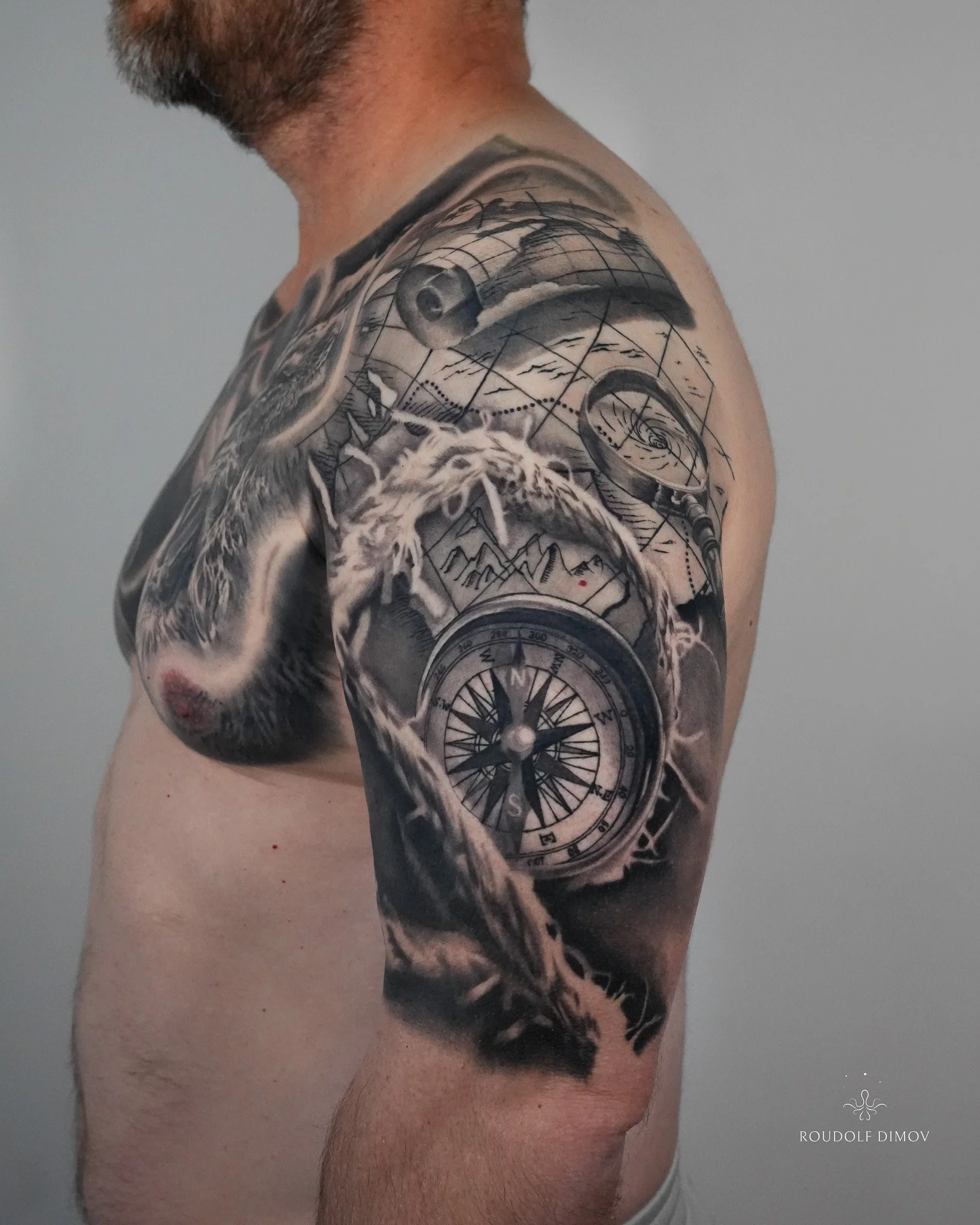
This arm was dedicated to the years he spent travelling around the world.
Many people choose compasses, maps, or nautical elements for travel tattoos — but the difference between a generic travel sleeve and a personalised one is how these elements interact.
The Elements He Wanted
A compass
Nautical rope
A vintage map
A magnifying glass
Small details that reflected years of travelling
Individually, these are common. But arranged carefully, they become part of someone’s personal story.
Making It Flow From the Chest
To avoid the arm feeling like a standalone tattoo, I extended the negative-space motion from the chest into the shoulder and upper arm. This subtle technique is what makes multi-area projects look intentional rather than disconnected.
It’s the tattoo equivalent of matching the lighting between scenes in a film — without it, everything feels separate.
Building the Composition
The compass became the centre point — not just visually, but symbolically.
The map settled behind it, giving the impression of a memory layered beneath the surface.
The rope wove through the design to create depth.
The magnifying glass became a quiet detail that grounded the theme.
This arm became the place where we brought his travel experiences to life — a natural continuation of the story that began on his chest.
With two sections done, only one final story remained.
Part III — The Arm for His Daughter: A Pocket Watch & Roses
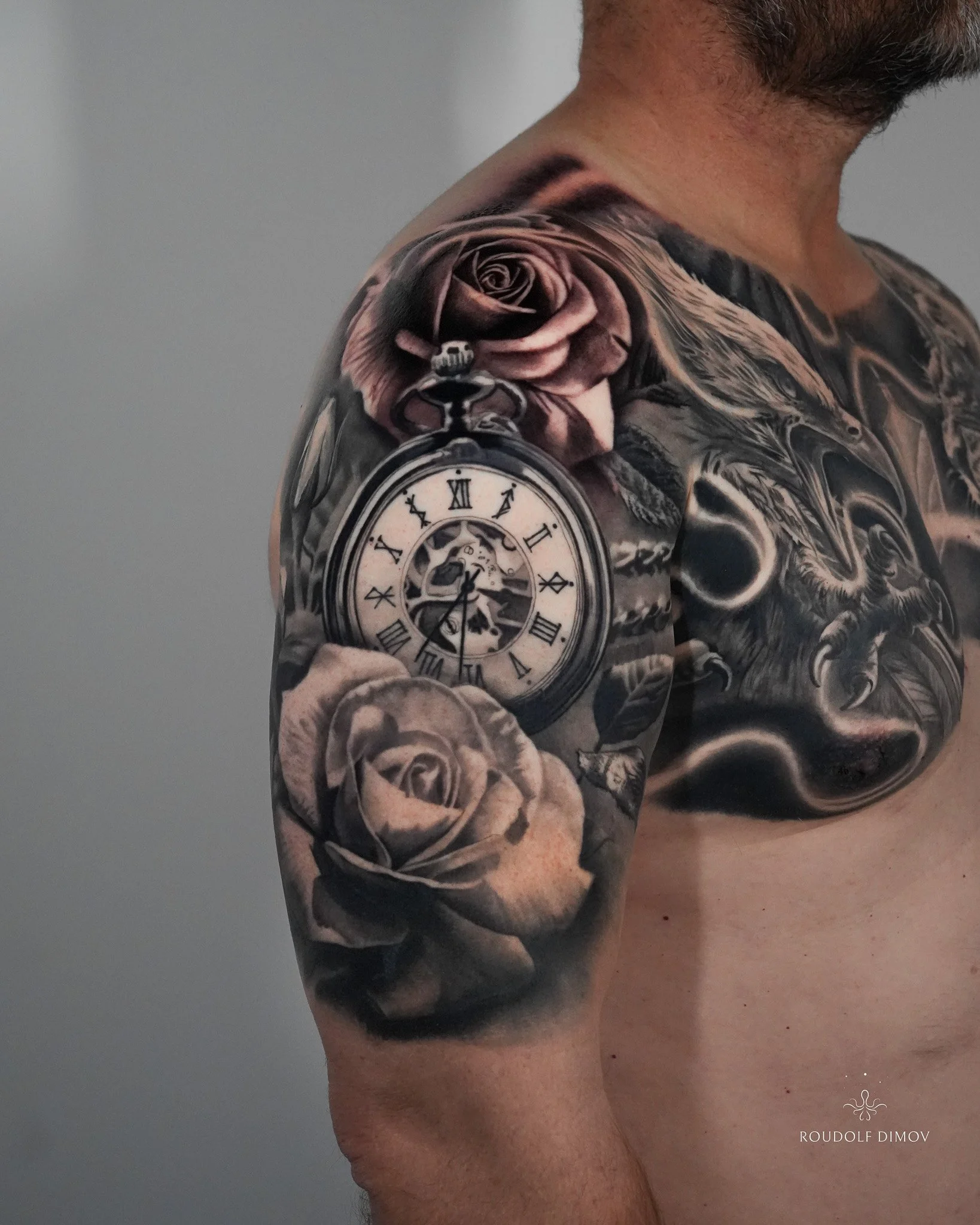
The last part of the project was the most personal one — a tattoo dedicated to his daughter.
The Idea
He wanted:
A pocket watch
Two roses
A softer, calmer composition that still connected to the rest
Pocket watches and roses are classic motifs. The challenge wasn’t the subjects — it was creating a version that felt truly his.
The Day Everything Shifted
We had a design ready. It looked good — balanced, detailed, well arranged.
But on the day of the appointment, something felt off. It wasn’t wrong, but it wasn’t complete.
I explained my thoughts honestly. I told him I wanted more time to rethink the flow and refine the composition properly. He trusted my judgment without hesitation, and we rescheduled.
The Redesign
When I returned to the drawing board, I focused on subtle but meaningful improvements:
Adding small rose buds and leaves to build a more dynamic composition
Introducing a pocket-watch chain woven softly into the background
Creating a more deliberate flow around the roses
Adjusting the lighting so the watch carried more presence
Softening certain areas to balance the strength of the other arm
Extending the same negative-space patterns from the chest and travel arm
These small additions transformed the piece.
It went from good to something truly personal — something that matched the meaning behind it.
Once the final version was done and tattooed, the chest and both arms locked together as parts of a single, intentional design.
Why This Project Meant So Much
Clients often choose classic elements — lions, eagles, roses, compasses, pocket watches. And there’s a reason: they’re timeless.
But timeless doesn’t mean generic.
My job as an artist isn’t to avoid familiar motifs. It’s to:
personalise them
compose them in a way nobody else has
make them feel like they belong to the client
connect them into a unified story
What made this project special was the collaboration. He trusted the process, trusted the adjustments, and gave space for the artwork to grow naturally.
Projects like this remind me that the best tattoos are built through conversation, patience, and an open mind.
What Clients Can Learn From This Process
1. You Don’t Need to Know Everything From Day One
A theme is enough. The details come through consultation.
2. Large Projects Work Best in Stages
Trying to design a chest + two arms at once forces rushed decisions.
3. Negative Space Is One of the Most Important Tools in Large Tattoos
It decides the flow, depth, readability, and overall cohesion.
4. Trust and Communication Improve the Final Design
The more open the conversation, the stronger the result.
5. “Common” Elements Aren’t the Issue — Poor Composition Is
Great tattoos aren’t about rare subjects. They’re about meaningful arrangement.
FAQs
How long do full chest + upper arm projects take?
It varies, but most multi-area projects take several sessions over weeks or months.
Is it okay if I don’t have a finished idea?
Yes — most clients start with only themes or feelings.
Can you connect tattoos I already have?
In many cases, yes.
Does a big tattoo hurt more?
Pain depends on the area, not the size.
What if something in the design feels off on the appointment day?
If something needs improvement, I’ll always bring it up.
How do you make common elements look unique?
Through composition, lighting, contrast, flow, and personal meaning.
🔎 Explore More FAQs:
https://www.roudolfdimovart.com/faq
Start Your Tattoo Journey
Whether you have a clear idea or just a theme, we can shape it together.
👉 Large Projects:
www.roudolfdimovart.com/large-projects
Bring your story. I’ll shape it into art.
👉 Book a Consultation:
https://www.roudolfdimovart.com/booking
📍 London
✉️ info@roudolfdimovart.com